








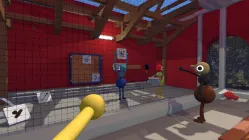
Big Walk is one of those games that makes a strong first impression before you’ve even settled into its rhythm. It does not chase the usual rush of objective markers, combat loops, or constant rewards. Instead, it leans into wandering, observation, and the small social moments that happen when a game trusts players to create their own fun. As someone who has spent years bouncing between sprawling open worlds, survival sandboxes, and experimental indie projects, I found Big Walk refreshing in the way it strips away noise and focuses on presence. It is not trying to be everything. It is trying to be a place you want to spend time in.
The first thing that stands out is the sense of scale. Big Walk presents movement as a core pleasure, and that matters more than it might sound. When a game asks you to simply walk, explore, and notice the world around you, the quality of traversal becomes everything. Here, that feeling is handled with care. The pace encourages curiosity rather than optimization. You do not race through the environment so much as drift through it, and that slower tempo gives the world room to breathe. In a market packed with games that constantly demand efficiency, that alone makes Big Walk feel unusual.
A world built for wandering
Big Walk is at its best when you stop treating it like a checklist and start treating it like a shared expedition. The terrain, environmental details, and general atmosphere work together to make each stretch of travel feel like a small discovery. That does not mean every moment is packed with spectacle. Far from it. The appeal lies in the confidence of the design. The game understands that an interesting path does not always need a reward at the end. Sometimes the journey is the reward.
That philosophy will appeal to players who like exploration games, social sandboxes, and relaxed co-op experiences. It may challenge those who need constant goals, but I think that tension is part of the point. Big Walk is not built for people who want a sprint; it is built for those willing to settle in, look around, and let the experience unfold at its own pace. If you like to install a game and immediately experiment with the world rather than following rigid instructions, this one lands in a satisfying sweet spot.
Co-op energy without the usual chaos
One of the biggest strengths of Big Walk is the way it handles shared play. A lot of multiplayer games confuse volume with energy, filling the screen with events until the whole thing feels noisy. Big Walk takes a more restrained approach. The social side feels organic, and that gives every interaction more weight. When you and your friends play together, you are not just stacking rewards; you are creating stories from movement, timing, and the occasional unexpected detour.
That makes it especially appealing for players who enjoy games that turn simple actions into memorable moments. You may start with a plan, then drift away from it because something strange, amusing, or oddly beautiful catches your attention. That sense of improvised play is where Big Walk shines. It feels less like a strict challenge and more like a digital place where friendships can develop naturally through shared exploration.
Why the pacing works
The pacing is deliberately gentle, but it never feels empty to me. There is a big difference between a game being quiet and a game being dead. Big Walk usually stays on the right side of that line because it gives players enough room to invent their own momentum. You are invited to take your time, read the landscape, and let the game’s systems support your curiosity rather than overwhelm it. That design choice will not suit everyone, but for the right audience, it is a major strength.
If you are searching for a quick download that delivers instant spectacle, Big Walk may feel understated at first. But spend time with it, and the confidence behind its design becomes clear. It knows exactly what kind of experience it wants to be, and it commits to that vision without apology.
Visual style and atmosphere
Big Walk does not rely on photorealism or flashy effects to leave an impression. Instead, it creates mood through composition, scale, and the way its spaces invite attention. The art direction supports the game’s identity beautifully. It is the kind of world that becomes more interesting the longer you remain in it, which is a rare quality. Many games front-load excitement and flatten out later. Big Walk does the opposite: it becomes more compelling as you learn how to move through it and what to notice.
The sound design also deserves credit. A walk-through experience can live or die by its audio, and this one uses ambience wisely. The world sounds alive without constantly shouting for your attention. That restraint helps the game feel grounded and immersive. It is easy to imagine long sessions where you lose track of time because the combination of motion, scenery, and audio keeps drawing you onward.
Who it is for, and who it is not
Big Walk is for players who like atmosphere, exploration, and social discovery. It is for people who enjoy the freedom to play at their own pace and who appreciate a game that respects silence. It is also a good fit for anyone who tends to sample indie releases looking for something different from the usual formula. Whether you want to free yourself from relentless objective markers or just enjoy a calmer multiplayer space, Big Walk offers a distinctive alternative.
It may not satisfy players who need combat, progression spikes, or heavy mechanical mastery. If your idea of fun depends on fast rewards or a dense systems layer, this may feel too open-ended. But if you are tired of games that over-explain themselves, Big Walk offers a welcome change. It trusts the player. That trust is one of the reasons it stands out.
What about cheats, mods, and other extras?
At the moment, Big Walk feels like the kind of game where cheats and mods could become part of the community conversation if the developer supports them, but the core appeal does not depend on that. It is not the kind of experience that begs for infinite resources or performance shortcuts. The fun comes from how you engage with the world, not from bending it into a power fantasy. If mods do arrive later, they may add novelty or customization, but the base game already has a very clear identity.
As for cheats, most players will probably not need them. The game is more about presence than pressure. If someone is looking for an unblocked route to victory, they may be misunderstanding what Big Walk is offering. This is a game where the value lies in the march itself.
Final verdict
Big Walk is a quietly confident game with a strong sense of place and purpose. It will not appeal to everyone, and that is exactly why it feels worth talking about. In a field crowded with loud, fast, overdesigned releases, this one leans into patient exploration and social spontaneity. That makes it memorable. I would rather play a game with a sharp identity than one that tries to please every audience at once, and Big Walk clearly belongs to the first category.
For players willing to slow down, share the space with others, and let the world reveal itself gradually, Big Walk is a smart download and an easy recommendation. It may not be the biggest game in terms of action, but it is big in spirit, and that counts for a lot.
How to download Big Walk
Availability & Launch: Big Walk is expected to be accessed through official store pages or the developer’s distribution channels when it launches. It may be a paid game rather than a free one, so check the store listing for the current status before you try to play.
Platforms: Supported platforms should always be confirmed on the official page. If a platform is not listed, the game is not available there natively. In some cases, cloud streaming or an emulator may be possible for unsupported devices, but that depends on the final release and storefront support. Check PC, Mac, and mobile listings carefully before you download.
Install: Go to the official store or launcher, search for Big Walk, purchase or claim it if required, then download and install it using the standard setup prompts. After installation, sign in if needed and launch the game from your library.
System Requirements: For PC or Mac, expect modest-to-midrange requirements depending on final optimization. For Android, look for a recent device with enough storage, a modern OS version, and stable performance. Exact specs should be checked on the official store page before install.
Cheats / Mods: Cheats are generally not part of the intended experience, and mod support is not guaranteed at launch. If mods become available later, they will usually depend on community tools or official support from the developer.
Unblocked Access: Big Walk is not guaranteed to be playable unblocked in school or work environments. Network restrictions, store access limits, and firewall rules may prevent play unless the game is already installed and approved on that device.
Pros
-
 Relaxed, exploration-first gameplay that encourages wandering and discovery.
- Strong social/co-op feel that creates memorable moments with friends.
- Deliberate pacing that makes the world feel calm and immersive.
- Distinctive atmosphere supported by solid art direction and sound design.
- Easy to pick up for players who enjoy low-pressure, open-ended experiences.
- Confidence in its design vision, giving the game a clear identity.
- Encourages emergent storytelling through simple actions and shared play.
Cons
-
 May feel too slow or empty for players who want constant action or combat.
- Open-ended structure can be unsatisfying for people who need strict objectives.
- Appeal depends heavily on the player enjoying atmosphere over progression.
- Possible mod and cheat support is unclear, limiting customization for some players.








Leave a comment
Your comment is awaiting moderation. We save your draft here
0 Comments